

Home
IDERHA’s bold ambition to transform healthcare and research through better use of data
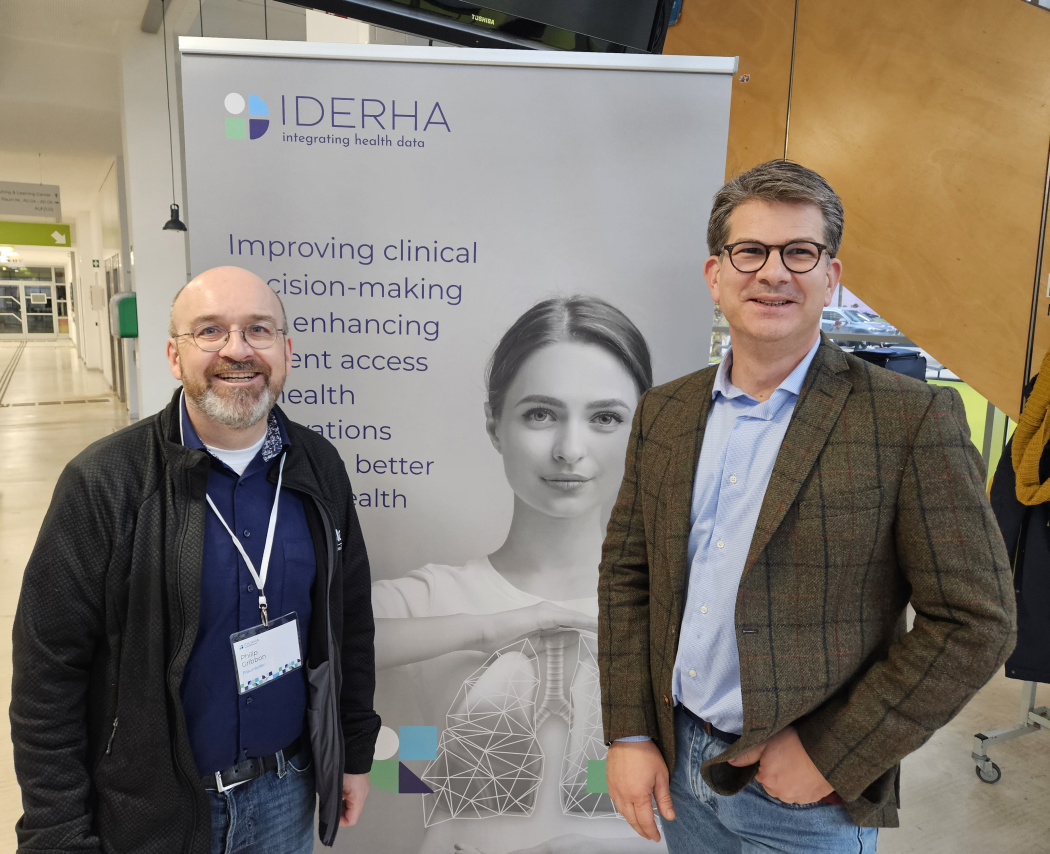
IDERHA aims to develop a platform that will integrate diverse health data, resulting in better patient care and more efficient research. Projects leads Phil Gribbon and Christian Muehlendyck reflect on the challenges, expectations, and their personal motivation to make a difference for patients. “We’re very optimistic about the positive impact IDERHA will have.”
Perhaps it’s a good idea to start by giving us an overview of the IDERHA project?
Phil: “The IDERHA project addresses the overall challenge of accessing health data. We’re moving towards an environment driven by the principle of not sharing data but accessing it. This new approach of data spaces presents both opportunities and challenges that need to be addressed from technical and governance perspectives. Our consortium is ideal for tackling these issues in a systematic way.”
What specific needs does IDERHA address?
Christian: “The primary need is to improve access to high-quality health data. We’re focusing on both the technical & legal challenges of data access and the benefits for patients. This includes addressing regulatory questions about the acceptance of heterogeneous health data for regulatory and HTA purposes. . The consortium is an ideal opportunity to address these needs comprehensively, with the partners from very different backgrounds. This is an optimal opportunity to get the maximum out of innovative technologies to drive healthcare for patients.”
How does IDERHA differentiate itself from other data-driven projects within the EU?
Phil: “One of our key differentiators is our focus on sustainability and building long-term value. We’re leveraging existing approaches and building bridges with other entities. Our project is also unique in its emphasis on patient-centered solutions and the involvement of regulatory bodies from the start.”
What are your expectations for the project’s impact on healthcare?
Phil: “We’re very optimistic about the positive impact IDERHA will have. By enhancing our digital presence and improving the process of achieving data access, we are setting the scene for increased patient satisfaction and better healthcare outcomes.
IDERHA is in its second year. Can you elaborate on the challenges you’ve faced so far and how you’ve overcome them?
Christian: “One of the biggest challenges is coordinating efforts across different departments and work-packages. We’ve implemented robust project management tools and fostered a culture of transparency and collaboration. Regular check-ins and updates have helped us stay on track and address any issues promptly. Additionally, we are addressing patient concerns in different areas, including data privacy and security. We are implementing robust data protection measures and ensuring transparency in how data is used. Our goal is to create a secure and open platform that fosters trust.”
Similarly, since IDERHA runs for 3.5 more years, you must have a clear idea of the biggest challenges ahead.
Phil: “Access to data remains a significant challenge. We need to establish trust and follow certain principles to make data access easier. Another challenge is maintaining momentum and alignment among our 32 partners, each with their own perspectives and expertises. However, we are confident that our clearly defined objectives and collaborative approach will help us overcome these hurdles.”
How do you envision the findings from IDERHA transferring to larger initiatives like the European Open Science Cloud?
Christian: “There will be a continuous learning effect in both directions. Our partners, such as Fraunhofer ISST, are key members of e.g. the Data Space Support Center for the European Data Space Initiatives such as the European Health Data Space. We are hence confident that the technology and learnings from IDERHA are likely find their way into these other initiatives, contributing to their success. The EOSC community are now establishing a series of health data space related projects, and we look forward to working with them to help define the optimal operating characteristics for the successful EHDS implementation”
How does IDERHA fit into larger overarching initiatives like the European Health Data Space (EHDS)?
Phil: “There’s still some ongoing discussion about how the EHDS and the European Open Science Cloud (EOSC) fit together in the long term. However, we see IDERHA as a key contributor to these initiatives. By aligning with the standards and principles of the EHDS, we can ensure that our work supports the broader goals of data interoperability and accessibility across Europe.”

Phil Gribbon, IDERHA academic lead“Our consortium is ideal for tackling several key issues comprehensively”
What role do regulatory bodies play in the IDERHA project?
Christian: “Regulatory bodies are central to our project. Building a technical solution is only the start. To be able to enhance health care all partners need to work together. In IDERHA We involve them from the start to develop consensus recommendations for the acceptance of Real-World-Data for regulatory and Health Technology Assessment. These discussions include all relevant stakeholders: authorities, patients, clinicians, industry, and academia in a very open mindset.
How do you address patient concerns about data privacy and security?
Phil: “Patient trust is crucial for the success of our project. We address privacy and security concerns by implementing robust data protection measures and ensuring transparency in how data is used. Our goal is to create a secure and open platform that fosters trust and encourages patient participation.”
What are some of the technical innovations you are working on?
Christian: “We are developing several technical innovations, including secure federated data access solutions and advanced data analytics tools. These innovations will enable us to access diverse data sets and extract valuable insights while maintaining data privacy and security. By leveraging cutting-edge technologies and combining them in a novel approach, we aim to drive significant improvements in this space.
One of the key principles is the use of federated data access solutions, which allows data to remain in its original location while being analyzed. Only the results will be available to the data access requester. Additionally, we are working on advanced AI enabled data analytics tools that can work in a federated environment. We will develop algorithms for personalized early risk profiling and malignancy risk prediction of lung cancer risk using electronic health records and image data. These tools will help us extract meaningful insights that can improve healthcare delivery and patient outcomes.”
How do you ensure the sustainability of the IDERHA project?
Phil: “Sustainability is a core focus of our project. We are building a long-term value network by adopting existing resources as part of our infrastructure design and creating synergies with other initiatives. Our approach includes continuous learning and adaptation to external developments, ensuring that our solutions remain effective over time. By fostering collaboration and building on existing technical approaches, we aim to create a lasting impact on healthcare.”

Christian Muehlendyck, IDERHA industry lead“The technology and learnings from IDERHA will likely find their way into larger initiatives”
What impact do you hope to achieve with the IDERHA project?
Christian: “Our ultimate goal is to improve patient care and outcomes through better data access and utilization. We aim to contribute to the broader healthcare ecosystem by enabling secure access to health data and driving innovation in data-driven healthcare solutions. Any solution that will enable early detection of diseases like lung cancer and enhancing treatment processes, can make a significant difference in patients’ lives.”
Can you share your personal motivations for being involved in this project?
Christian: “As a former clinician, my motivation is to improve data-based decision-making in healthcare. Early detection of diseases like lung cancer can make a huge difference, and I believe IDERHA can play a role in these efforts. The burden of lung cancer is enormous, and our focus on early detection and patient care improvement is what drives me.”
Phil: “For me, it’s about the untapped opportunity to use high-quality image data and electronic health records to improve patient outcomes. I recently lost a very close friend to lung cancer, and this project is one way for me to contribute to making early detection and better care a reality for others.”
Thank you for sharing these insights. Is there anything else you’d like to add?
Phil: “Just that we’re incredibly excited about the future and grateful for the hard work and dedication of all the talented individuals from both academia and industry who contribute to IDERHA. We’re confident that IDERHA will set a new standard for data-driven healthcare and make a meaningful impact on patient care.”
Christian: “I would like to add that our consortium’s commitment to transparency and collaboration is a core driver for us. We are dedicated to working closely with all stakeholders, including patients, clinicians, and regulatory bodies, to ensure that our solutions are not only innovative but also practical and beneficial for everyone involved.”