Home
IDERHA Stakeholder Meeting Unites Key Players in Austrian Healthcare
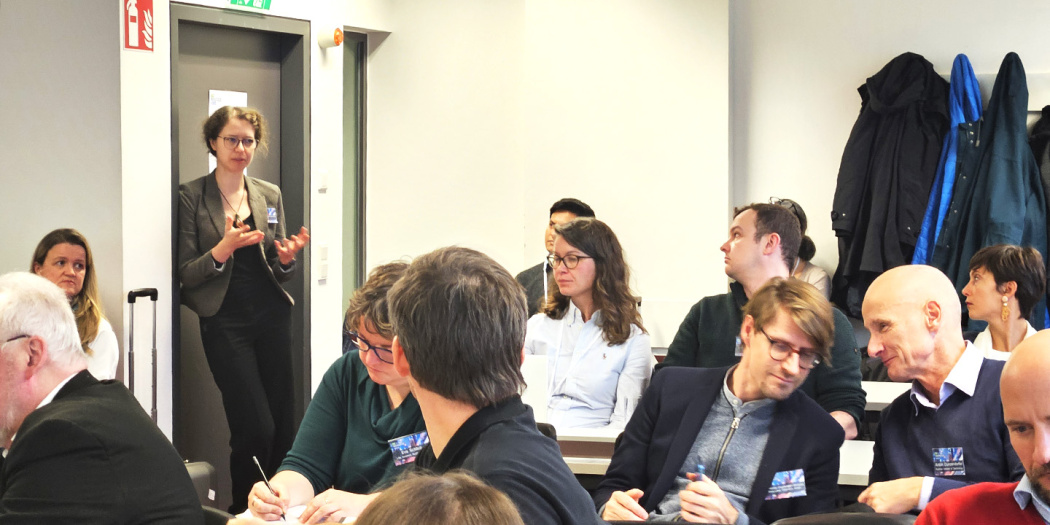
The ‘IDERHA and EU-DataSpaces Stakeholder Meeting’ convened on 28 November in Vienna, bringing together a diverse array of technical staff from Austrian healthcare system stakeholders.
The event saw participation from national institutions, data providers, data users, social insurance providers, industry representatives, SMEs, and researchers, all eager to contribute to the future of healthcare data management.
The meeting kicked off with an introductory session that provided participants with a comprehensive overview of the IDERHA project. This included insights into the project's architecture, legal framework, and future operational plans. Following a brief intermission, the discussion delved into critical topics such as data standards, use cases, and data analysis. The session culminated with a captivating demonstration of the future citizen app, accompanied by insightful policy recommendations.
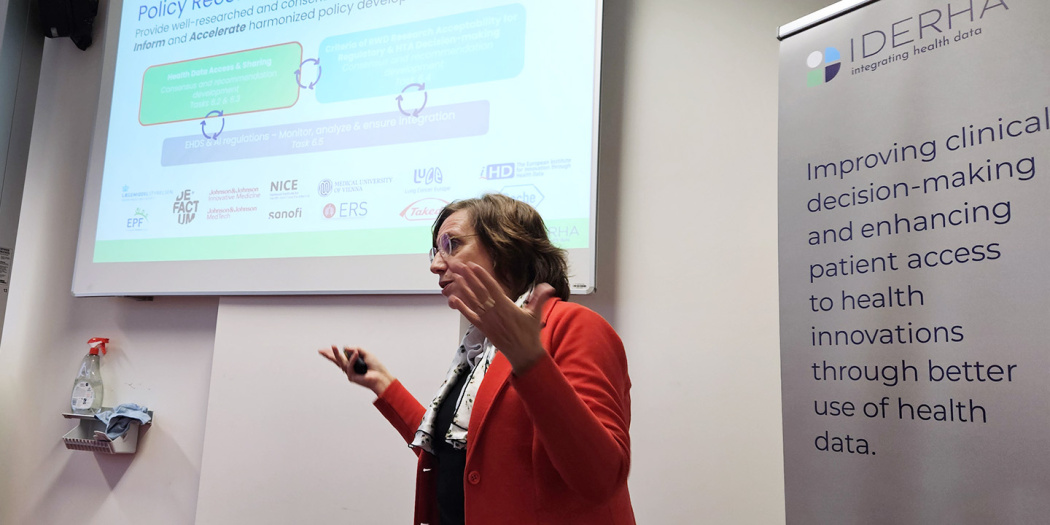
One of the highlights of the meeting was the announcement of an ongoing onboarding process for future data holders, some of whom were present at the event. This initiative underscores the project’s commitment to expanding its reach and impact within the healthcare sector.
The event also featured a dynamic panel discussion and Q&A session, allowing participants to engage in meaningful dialogue and address their queries directly with the experts. Key questions and answers were collected and are provided below.
-
Is the data holder responsible for data anonymization?
Data holders will ensure pseudonymisation and/or anonymization of data according to the internal standards and IDERHA requirements/recommendations before making the data available in the Secure Processing Environment (SPE) or Federated Node.
-
If ML is performed on the premises of the data holder, how is it ensured that there is the necessary infrastructure, e.g. GPU clusters for deep learning?
IDERHA will define technical requirements for setting-up a Federated Node and enabling specific computations on it. Depending on the data types available at the data holder and the computational complexity of the algorithms they wish to offer, the data holder may decide to go for on-premise computation (if sufficient technical infrastructure is available) or may choose cloud vendors for computation.
-
Use case: An external company developing a Lung cancer AI wants to train on the data. Is IDERHA interested in this already? If so, in what time frame?
Any bona fide organisation (company, academic, regulator, etc.) should be able to use the IDERHA platform to access data under a federated approach in order to train AI models. In the case of a company, they would have a specific data set(s) in mind, and that existing or new data holder(s) would be also engaged as part of the onboarding process of the AI company. Timescale estimate is Q1/2 2027 onwards.
-
How do you ensure security in times of cybercrime and hybrid warfare?
The IDERHA platform is envisioned to implement a multi-layered security approach, designed around the principle of "zero trust" and data sovereignty, as well as for compliance with data protection regulations. A secure federated infrastructure will be implemented by adopting state-of-the-art technical standards and approaches for multiple authentication layers, strict access controls and data minimisation techniques for decentralized data storage, Secure Processing Environments (SPE), algorithm security mechanisms, etc. This will be enforced through regular security audits and monitoring, and in the future potentially also validated with adequate security certifications.
-
What role can (national) cancer registries play in IDERHA?
These entities are welcome to become data holders and provide access to IDERHA users.
-
How do you operationalise the ethics risk assessment in the DMP?
All risk mitigating measures identified within the ethics and data protection impact assessments are implemented into the technical and organizational standards. These are applicable consortium-wide and contained within Part 6 of the DMP. The fact that the DMP is a living document allows us to take swift account of a changed risk perspective and adequately update our security standards.
-
How does the GA4GH passport go together with the European eID standards? Is this complementary?
They are complementary solutions, used primarily for user authentication (eID) and user authorisation (GA4GH passports) in IDERHA's OIDC-based AAI approach.
-
Is access granted only where the requester can ensure fulfillment of ethical criteria and public value of their research? How is this be examined?
The ethical criteria willbe examined by the ethics committee as per the clinical data usage best practices to make sure that the research is conducted with a noble ground. In the Data Access Request (DAR) process, a data requester submits the project proposal via the IDERHA platform to the data holder along with sufficient documents to prove the researcher's identity, affiliation, and background. The DAR will be manually assessed by Data Access Committee (DAC) and at the end a Data Steward will take the decision whether to provide data access, or re-submission of the project proposal is required, or reject the data access request. Data access criteria will be defined individually by each data holder, and will be communicated to the platform users as part of metadata of each dataset in the IDERHA catalog.
The meeting was graced by representatives from several esteemed institutions, including:
- ELGA - Electronic Health Records (owned by the Ministry of Health)
- GÖG - Austrian National Public Health Institute (Gesundheit Österreich GmbH)
- ÖGK - Social Health Insurance (public body)
- AUVA - Social Health Insurance for accidents (e.g., at work)
- AIT - Austrian Institute of Technology (Project: Smart FOX)
- Statistics Austria (cancer report)
- LISAvienna (cluster platform for life sciences in Vienna)
- Chamber of Labour Vienna
- SMEs, Startups, researchers, and representatives of other (EU) funded eHealth projects
The meeting marked a significant milestone in the journey towards a more integrated and efficient healthcare data ecosystem in Austria. The collaborative efforts and insights shared during the event are set to pave the way for innovative solutions and improved healthcare outcomes.