

Home
IDERHA in the spotlight Part 1: Simon Scheider
In our new interview series about the people that drive IDERHA, Early Career Community member Simon Scheider is the first to step in the spotlight. Find out why he would like to have dinner with Charles Babbage, and how he ended up in data science after a career in corporate finance.
Can you share some insights into the work you are doing in IDERHA? And why is your work important?
In IDERHA, I act as a Product Owner for the team of Fraunhofer ISST. My work focuses on the conceptual and technical development of the IDERHA core infrastructure, particularly its federated data management approach (WP1) and the integration of data holders into the data space (WP3). The work of our team is crucial for the project's success, as we implement key parts of the overall technical solution, which is the IDERHA data space.
Looking ahead five years, what profound impact do you envision your project will have on both your personal growth and the broader landscape of your field?
I hope that IDERHA will show new ways of making valuable health data available to various research initiatives at large scale by effectively combining modern technologies and established standards in a data space approach that handles the associated legal, ethical and economic challenges. Personally, I realized from the very beginning that working closely with IDERHA’s many experts helps me to learn quickly. This learning includes not just technical knowledge, but also important soft skills like presenting, moderating, communicating, team facilitating, et cetera.
If you were to deliver a TED talk, what would be the topic you'd choose, and why do you think it’s interesting enough for everyone to hear?
I would focus on the sheer boundless potentials of personal data to transform our lives – for the better or worse. In IDERHA, we only look at a very small fraction of humans’ digital life journeys (i.e., some specific types of healthcare data). However, we also produce personal data related to financials, education, employment, consumption, social, communication, biometric, mobility & location, lifestyle, et cetera. In my TED talk, I would imagine what a world needs to look like to enable us exerting full control over all our data (i.e., our personal digital twin), while making it utilizable within the global data economy.
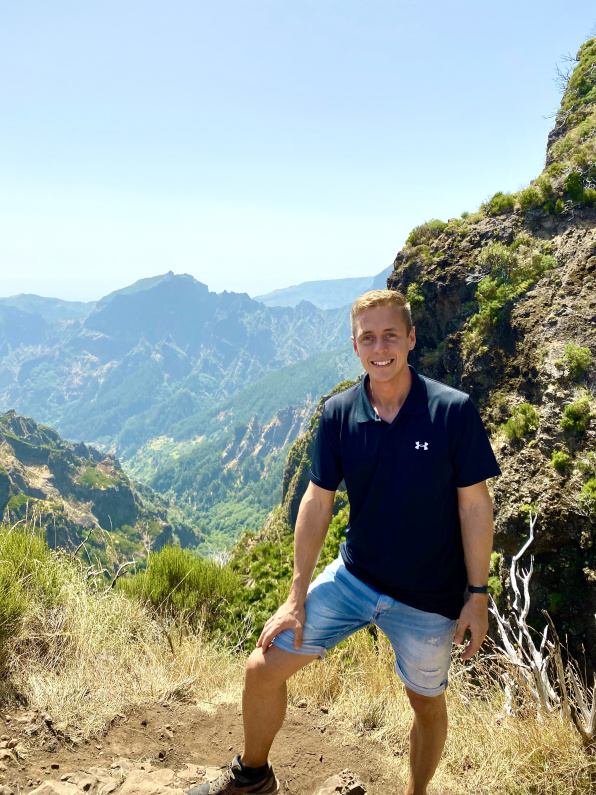
If the world of research hadn’t been your calling, what alternative career path do you think you might have taken? And why didn’t you take it?
Honestly, I never planned to go into research. I first worked in corporate finance and then shortly in logistics. By chance, I became a student assistant at a Fraunhofer institute in southern Germany, where I discovered my passion for science in general. Since there weren't any suitable positions available after I graduated, I moved to Fraunhofer ISST because I thought data spaces and healthcare could be interesting. So far, it’s been the best career decision I’ve ever made.
Share with us your ideal way to spend a day off, whether it's a thrilling adventure, a cozy retreat, or an exploration of something new and exciting.
On my days off, I like to stay active. I enjoy bouldering, biking, and hiking. Sometimes, I also visit the Dutch coast or make a city trip. Usually, the more days I have off, the farther I like to travel.
If you could have dinner with any three individuals, living or deceased, who would they be and why?
- Leonardo da Vinci because he was one of the greatest all-round talents in history. I’d love to hear what this genius from the past thinks about our modern world. For example, he designed a model of an airplane over five centuries ago. What would be his opinion about airplanes 500 years later?
- Albert Einstein because he was one of the most famous scientists, contributing ground-breaking discoveries in physics and our understanding of reality. I’m also curious about what was missing in my high school presentation on general theory of relativity, which only got me an average grade. Unfortunately, my physics teacher could never explain me why.
- Charles Babbage because he was a pioneer in computing and is considered the inventor of the computer.
Dive into the world of science-related entertainment - what's your absolute favourite movie, TV series, or book, and why should everyone see or read it at least once?
I would recommend the book “The Universe in a Nutshell” by Stephen Hawking. Firstly, it explains complex yet highly interesting theories and concepts in cosmology and physics in an engaging way. Secondly, it gives a huge perspective on our place in the universe, showing how small most of our personal problems and worries might be. Finally, after reading more than 200 pages of highly challenging content, you simply feel proud of yourself!
If you had the magical ability to master a new skill in just 24 hours, what skill would you choose and why?
I would like to master the skill of mastering new skills in just 24 hours. It would make life much easier.